Daphne's Hand
Gio Ponti, Elena Diana
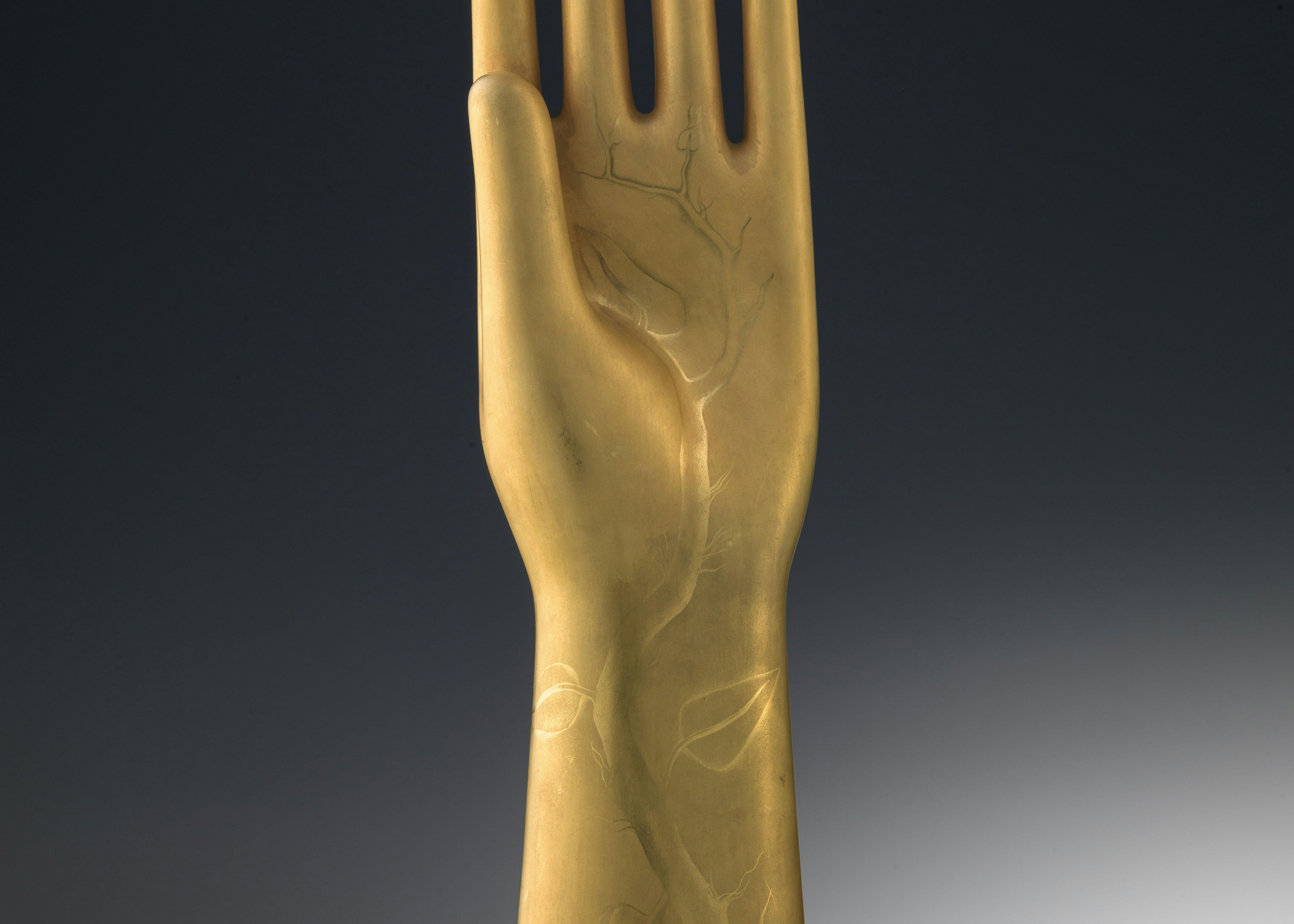
The Hand of Daphne, decorated on both sides in agate gold with branches and leaves extending to the fingers, refers to the well-known myth recounted in Ovid’s Metamorphoses. The nymph Daphne, to escape the passionate love of the god Apollo, called upon the gods for help and was transformed into a tree. Along with the Witch’s Hand (inv. 3204), the Hand with Gold Symbols (inv. 3206) and the two Flowered Hands (invv. 3207, 3208), it is part of a series conceived by Ponti in 1935, when he had already stepped down from his role as artistic director of Richard-Ginori. This is confirmed by the date present next to the signature on some of the pieces.
Ponti probably designed all five decorations for the Paris exhibition L'art italien des XIXe et XXe siècles, for which, together with Piero Chiesa, he curated the section dedicated to applied arts. The execution of the decoration is almost certainly the work of Elena Diana, a master of the agate gold technique at the Manifattura Ginori.
The hands preserved at the Ginori Museum are unique objects made by using an existing serial article as a base, specifically white porcelain moulds produced by Richard-Ginori for rubber and latex glove manufacturers. Ponti transformed them into works of art through the originality of the design and the use of precious techniques such as, in this case, the burnishing of gold with an agate tip.
- 01
- 02
Hand of Daphne 2
- 03
Mano di Dafne 3


The Hand of Daphne, decorated on both sides in agate gold with branches and leaves extending to the fingers, refers to the well-known myth recounted in Ovid’s Metamorphoses. The nymph Daphne, to escape the passionate love of the god Apollo, called upon the gods for help and was transformed into a tree. Along with the Witch’s Hand (inv. 3204), the Hand with Gold Symbols (inv. 3206) and the two Flowered Hands (invv. 3207, 3208), it is part of a series conceived by Ponti in 1935, when he had already stepped down from his role as artistic director of Richard-Ginori. This is confirmed by the date present next to the signature on some of the pieces.
Ponti probably designed all five decorations for the Paris exhibition L'art italien des XIXe et XXe siècles, for which, together with Piero Chiesa, he curated the section dedicated to applied arts. The execution of the decoration is almost certainly the work of Elena Diana, a master of the agate gold technique at the Manifattura Ginori.
The hands preserved at the Ginori Museum are unique objects made by using an existing serial article as a base, specifically white porcelain moulds produced by Richard-Ginori for rubber and latex glove manufacturers. Ponti transformed them into works of art through the originality of the design and the use of precious techniques such as, in this case, the burnishing of gold with an agate tip.