Laboratory porcelain
Crucible with perforated bottom, funnel, and capsule with spout
Since the second half of the nineteenth century, the Manifattura Ginori has produced porcelain laboratory items. Among the artifacts related to the production of objects for experiments or for the chemical and pharmaceutical industries are small beaker cups with a spout, chemical mechanical filters for purifying water, common and filtering funnels, mortars and pestles, perforated ladles or ladles with a spout.
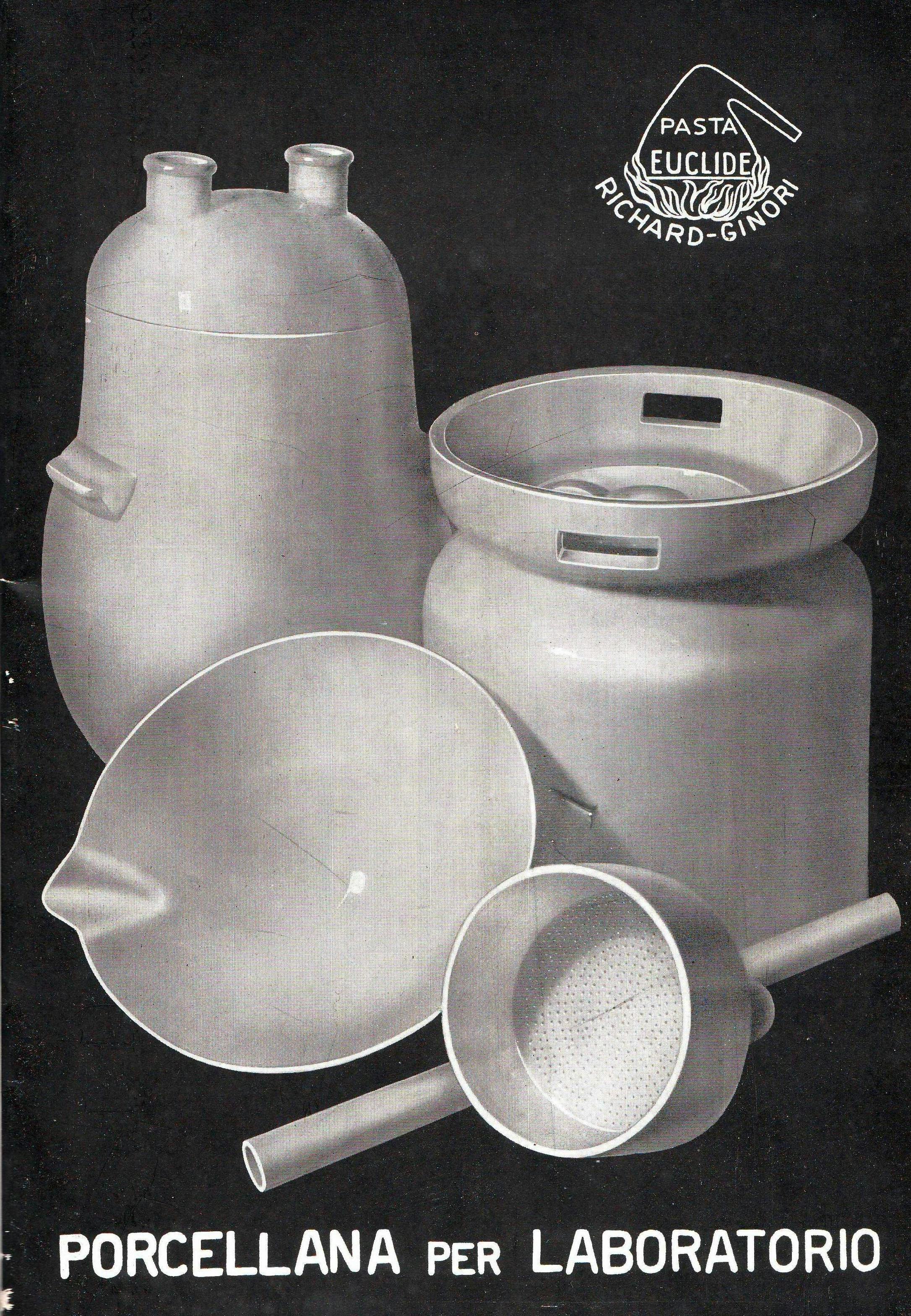
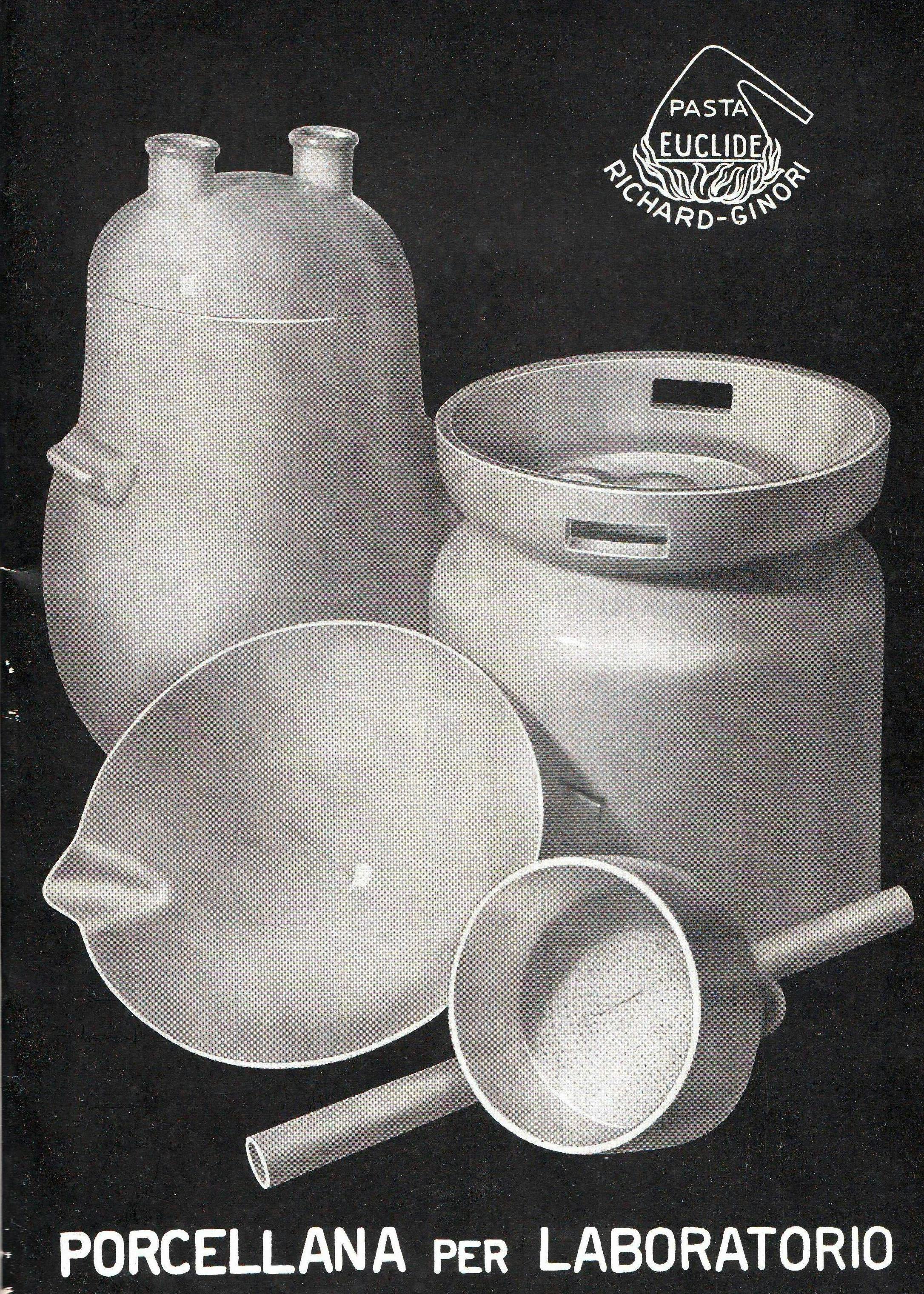
On December 3, 1940, the Società Ceramica Richard-Ginori in Milan registered the trademark Pasta Euclide, enclosed within a distillation flask placed over a flame, with the inscription Richard-Ginori in capital letters below. For this reason, it is possible to date the specimens bearing this special mark to the 1940s. At the Museo Ginori Archive, there is also a catalog of porcelain laboratory items Pasta Euclide produced by Richard-Ginori, unfortunately undated but almost certainly from the same years.
The porcelain of these items was of the refractory type, meaning it was more resistant to heat, mechanical stress, and the action of acids and bases, and therefore perfectly suitable for the intended use. In the photo, a funnel with an internal filter (inv. 8169), a crucible with a perforated filtering bottom (inv. 8143), and a capsule with a spherical bottom and spout (inv. 8153) are visible, of the same type illustrated on the cover of the Porcellana per laboratorio catalogue.
- 01
Laboratory porcelain
Since the second half of the nineteenth century, the Manifattura Ginori has produced porcelain laboratory items. Among the artifacts related to the production of objects for experiments or for the chemical and pharmaceutical industries are small beaker cups with a spout, chemical mechanical filters for purifying water, common and filtering funnels, mortars and pestles, perforated ladles or ladles with a spout.
On December 3, 1940, the Società Ceramica Richard-Ginori in Milan registered the trademark Pasta Euclide, enclosed within a distillation flask placed over a flame, with the inscription Richard-Ginori in capital letters below. For this reason, it is possible to date the specimens bearing this special mark to the 1940s. At the Museo Ginori Archive, there is also a catalog of porcelain laboratory items Pasta Euclide produced by Richard-Ginori, unfortunately undated but almost certainly from the same years.
The porcelain of these items was of the refractory type, meaning it was more resistant to heat, mechanical stress, and the action of acids and bases, and therefore perfectly suitable for the intended use. In the photo, a funnel with an internal filter (inv. 8169), a crucible with a perforated filtering bottom (inv. 8143), and a capsule with a spherical bottom and spout (inv. 8153) are visible, of the same type illustrated on the cover of the Porcellana per laboratorio catalogue.