Academic artists at the Manifattura di Doccia
In the second half of the nineteenth century, painters and sculptors from the Academy increasingly collaborated with the Manifattura Ginori.
The archival evidence preserved at the Museo Ginori documents the constant presence of sculptors and painters at the factory. The first names mentioned are Vincenzo Foggini, Giovan Battista Piamontini, Lorenzo Maria Weber, and Antonio Selvi, who were active in Doccia already in the early years following the establishment of the factory (1737).
However, it is in the second half of the nineteenth century that this relationship intensified, probably coinciding with the beginning of the International Exhibition era, where, amid the bustling crowd of curious visitors and collectors, artists could also be seen striving to promote their talent at the factories participating in the event.
Jafet Torelli
The first academic whose presence is documented at Doccia is the sculptor Jafet Torelli, active at the Manifattura Ginori from 1865 to 1873. Trained at the Academy of Fine Arts in Florence under the sculptor Aristodemo Costoli, and later in Paris in the workshop of the Turin ceramist Giuseppe Devers, Torelli immediately took on the roles of chief modeller, designer, and director of the "Raw Processing" and the "Form Workshop" at Doccia. A testament to his activity remains in the Museo Ginori in the form of an album containing drawings of items he created for the factory, including a small table with griffins and putti, exhibited in Vienna in 1873 (inv. 4), and some vases with serpentine handles ending in harpies.
Giuseppe Benassai
Contemporary testimonies link the end of Torelli's collaboration with Doccia to the arrival of the Calabrian painter Giuseppe Benassai, honorary professor at the Academy of Fine Arts of Florence, who became the artistic director of the factory in 1873, when Paolo Lorenzini was the director of the establishment. With Benassai, the style of the Neapolitan school, where he had trained, came to Doccia. He is credited with introducing a more painterly way of decorating and with increasing the presence of landscapes and animals in the decorative repertoire, which sometimes become predominant.


Giuseppe Benassai and Manifattura Ginori, Plate depicting a pair of deer in a forest. Majolica, 1872, Museo Ginori


Giuseppe Benassai for Manifattura Ginori, Airone jewelry holder, porcelain, circa 1873, Museo Ginori
Achille Melloni
Achille Melloni arrived in Doccia in 1879, just after graduating from the Academy of Fine Arts of Bologna. The factory’s production records kept at the Museo Ginori mention a wall basket and two jardinières made by him between 1880 and 1881, which were presented to great public acclaim at the Milan Exhibition of the same year.


- Achille Melloni for Manifattura Ginori, Planter with eagles, maiolica, 1881, Museo Ginori
Giovanni Muzzioli
Well known for the quality of his canvas painting, Giovanni Muzzioli from Modena arrived at Doccia after studying at the Accademia di San Luca in Rome and then in Florence, where between 1882 and 1883 he became president of the newly founded Circolo Artistico. His collaboration with the Manifattura Ginori is documented at the Turin exhibitions of 1880 and Milan of 1881. At the latter, a pair of vases "with satyr handles" and one "with figures," featuring fully sculpted figures resting on the body and rim, are attributed to his invention.
Odoardo Borrani
Examples of vases animated by plastically modeled figures appear prominently at the 1884 Turin Exhibition, as seen in the photo of the Ginori pavilion, which on the left shows a tuba-shaped vase with two figures seated on the body and a large vase with a mouth enlivened by putti playing with a garland of flowers. The latter has a body decorated with a scene taken from a painting by the Florentine Odoardo Borrani. In an article published in the exhibition’s newspaper, Giuseppe Corona describes them as follows: “These two vases can be called classical in form, concept, and painting, which some might find even too refined. They are in fact true paintings whose subjects belong to Prof. Borrani.”
Trained in Florence studying the frescoes of Giotto, Paolo Uccello, and Domenico Ghirlandaio, in 1854 Borrani enrolled at the Academy of Fine Arts in Florence. In the same year, a close friendship with Telemaco Signorini brought him closer to en plein air painting and to the Caffè Michelangelo, from where the Macchiaioli painting revolution began. The Museo Ginori preserves two wall plates attributable to Borrani: one with a female portrait presented at the 1884 Paris Exhibition and described in the documents as “Large Plate with a figure by Borrani in the centre and decorated with chiaroscuro on a blue background on the rim,” the other sent to the 1893 Zurich Exhibition, as revealed by the photo of the pavilion and the shipment note description: “Large Plate with a portrait of the German Prince in the centre, with gold, on a dark gray background, highlighted in gold, and rim with chiaroscuro ornaments on a blue background M.o 393.”

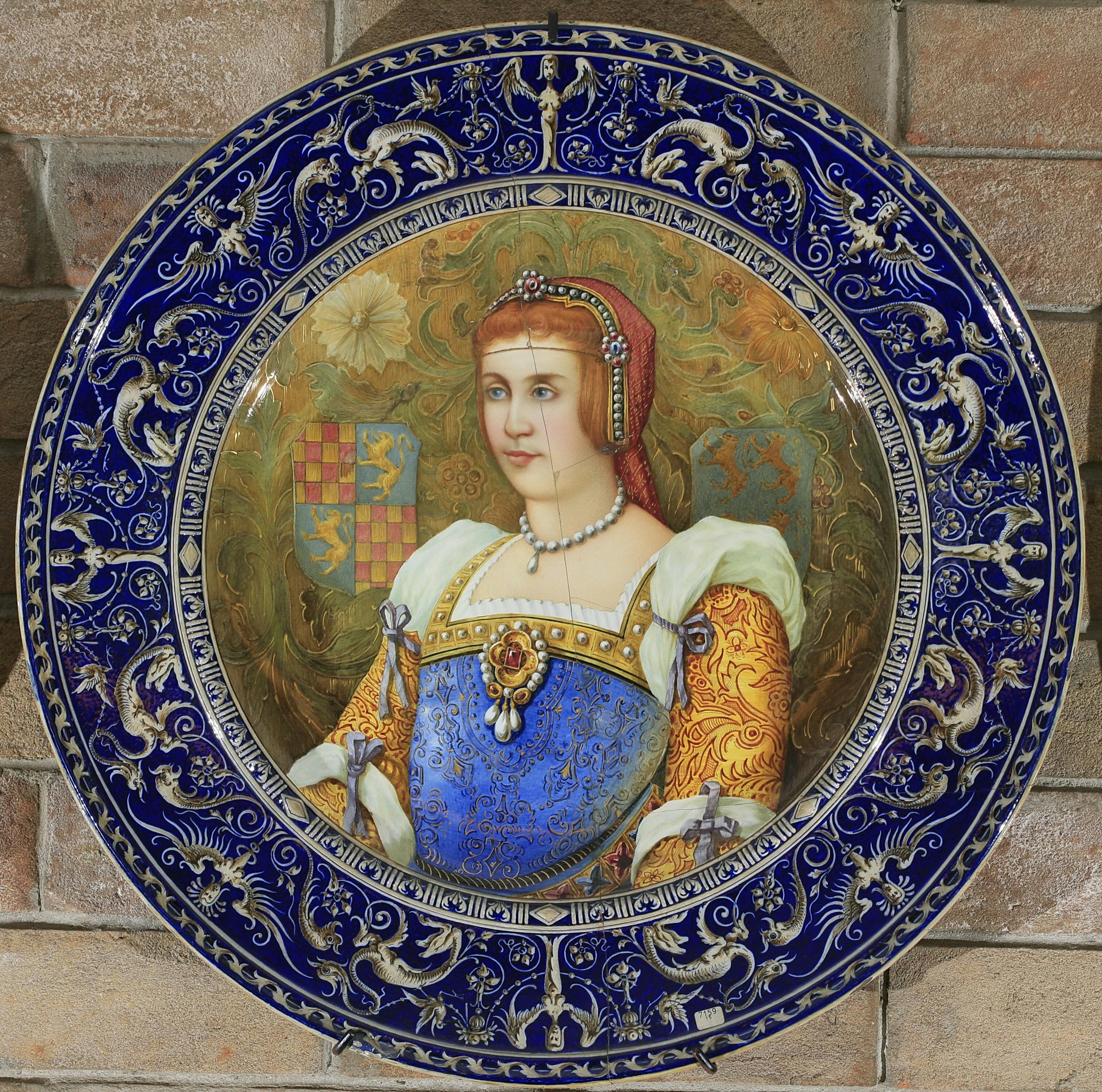
Odoardo Borrani, Plate with portrait of a noblewoman, maiolica, circa 1884, Archive of the Ginori Museum
Watercolour sketches signed by Borrani and dated 1884 are also preserved at the Museo Ginori. These are two half-length portraits of a lady and a “German prince” in Renaissance attire, emerging from a background filled with flowers and leaves, simulating a brocade curtain. The plate with the female figure, which given its state of preservation can be identified with the example recorded as broken among the documents from the 1884 Paris Exhibition, is in the collections of the Museo Ginori.
After 1884, there is no further trace of Borrani’s presence at Doccia. It is therefore reasonable to think that his collaboration was occasional, probably due to his friendship with the sculptor Urbano Lucchesi, his next-door workshop neighbour.

Odoardo Borrani, Plate with portrait of a noblewoman, watercolor on cardboard, signed and dated 1884, Archive of the Ginori Museum

Odoardo Borrani, Plate with portrait of a noblewoman, watercolor on cardboard, signed and dated 1884, Archive of the Ginori Museum, detail of the signature
Odoardo Borrani, Plate with "portrait of a German prince," watercolor on cardboard, signed and dated 1884, Ginori Museum Archive
Urbano Lucchesi
In 1881 Lucchesi is recorded as active at the Ginori factory with the title of artistic director. However, his real debut only took place at the 1884 Turin Exhibition, where the innovations he introduced into the factory's production were displayed, such as the bizarre and unexpected flower and paper holders, partly visible in the photo of the Ginori pavilion. On the back wall of the photograph, there is a bust of a woman and a Newspaper Seller, both serving as flower vases, while at the centre stands out the fountain with harpies and little tritons supporting large shells topped by a Venus with a body covered by shimmering drapery and garlands. The large vase decorated with playful putti is also stylistically attributable to Lucchesi's invention.


View of the Ginori pavilion at the 1884 Turin Exhibition, photograph, 1884, Ginori Museum Archive
The putti in playful poses would later have great significance in the sculptor's production for the Manifattura di Doccia, alongside genre and allegorical figures that reveal a careful study of anatomy and portraiture, attributable to the years he spent at the Florence Academy of Fine Arts under the guidance of Giovanni Dupré.

Urbano Lucchesi for Manifattura Ginori, card holder in the shape of a putto riding a fantasy fish, maiolica, circa 1883, Museo Ginori

Urbano Lucchesi for Manifattura Ginori, Duck-shaped paperweight with putto, majolica, 1884-1900, Ginori Museum

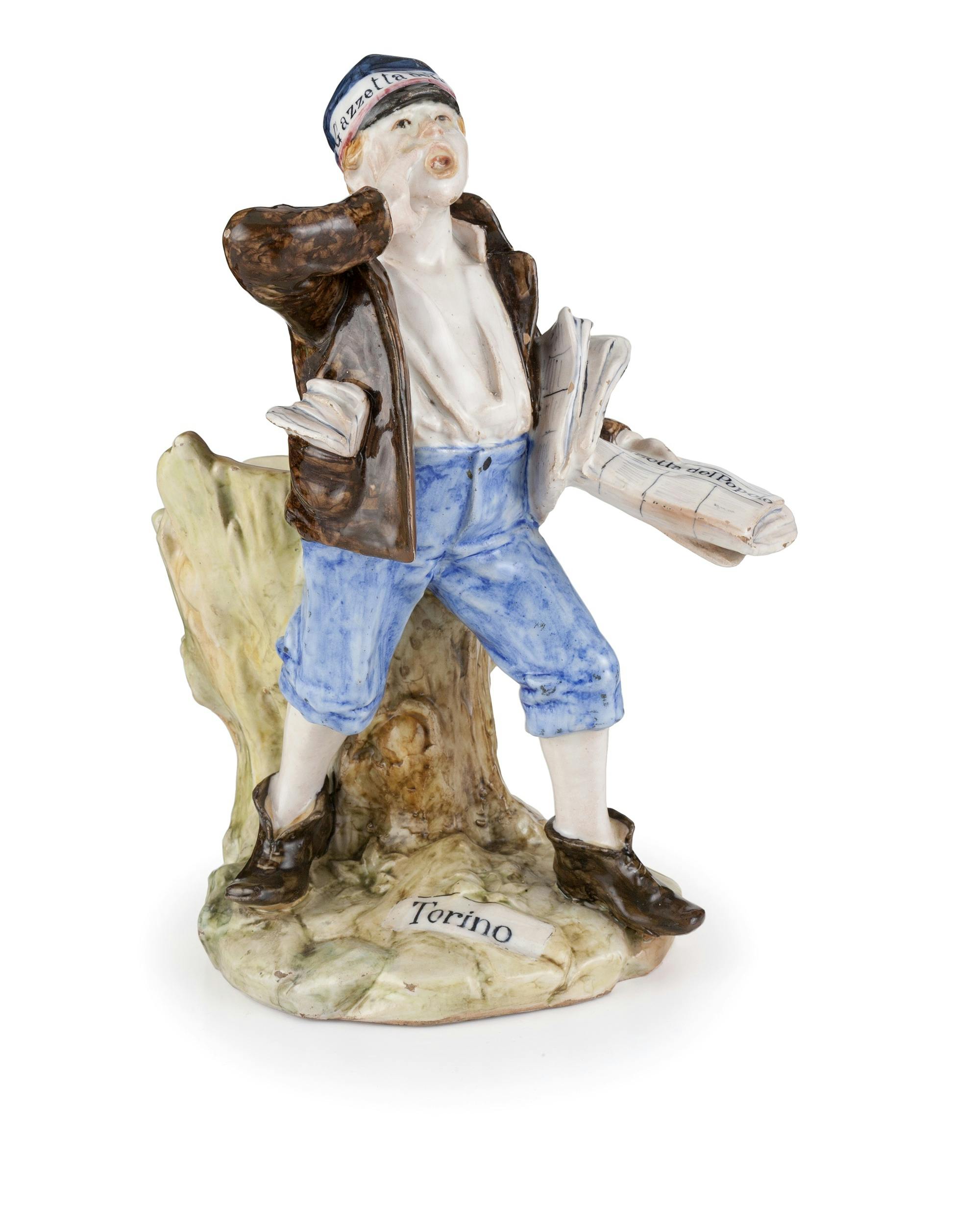
Urbano Lucchesi for Manifattura Ginori, flower holder depicting a "Newspaper Seller," maiolica, circa 1884, Museo Ginori
The introduction of painting inspired by literature into the factory was also due to Lucchesi (and Borrani), which in the nineteenth century found ample space, perhaps as a response to academic classicism still animated by an eighteenth-century spirit. Among the pages of the journal of the 1884 Turin Exhibition, there is an illustration of a vase with the figures of Boccaccio and Fiammetta, while on another vase presented in Palermo in 1891, the protagonists of Goethe’s Faust are evoked, dressed in medieval clothing reminiscent of those in The Kiss painted by Francesco Hayez in two versions, one in 1859 (Milan, Pinacoteca di Brera) and the other in 1867 (private collection), stylistically consistent with two Ginori plates depicting a lady and a prince designed by Borrani.
The literary genre represented on the two vases belongs to troubled loves, a theme dear to nineteenth-century artists who also celebrate Paolo and Francesca and Romeo and Juliet in a theatrical key on their canvases. The same theatricality is found in the two vases, where the sculptures seem to engage in dialogue against the backdrop of a pictorial landscape that serves as a scenic setting.
The presence of these vases and plates at the 1884 exhibition reflects the taste for the neo-Gothic and neo-Renaissance revival, which also finds its counterpart in the Middle Ages Village built in the same year in Turin’s Valentino Park.
Raffaello Pagliaccetti
Under the artistic direction of Lucchesi, another sculptor with an academic background also worked, the Abruzzese Raffaello Pagliaccetti, author of the roundels with the effigies of Leonardo, Michelangelo, Donatello, and Luca della Robbia and of a jardinière with the Triumph of Venus and Love, presented at the 1873 Vienna Exhibition.

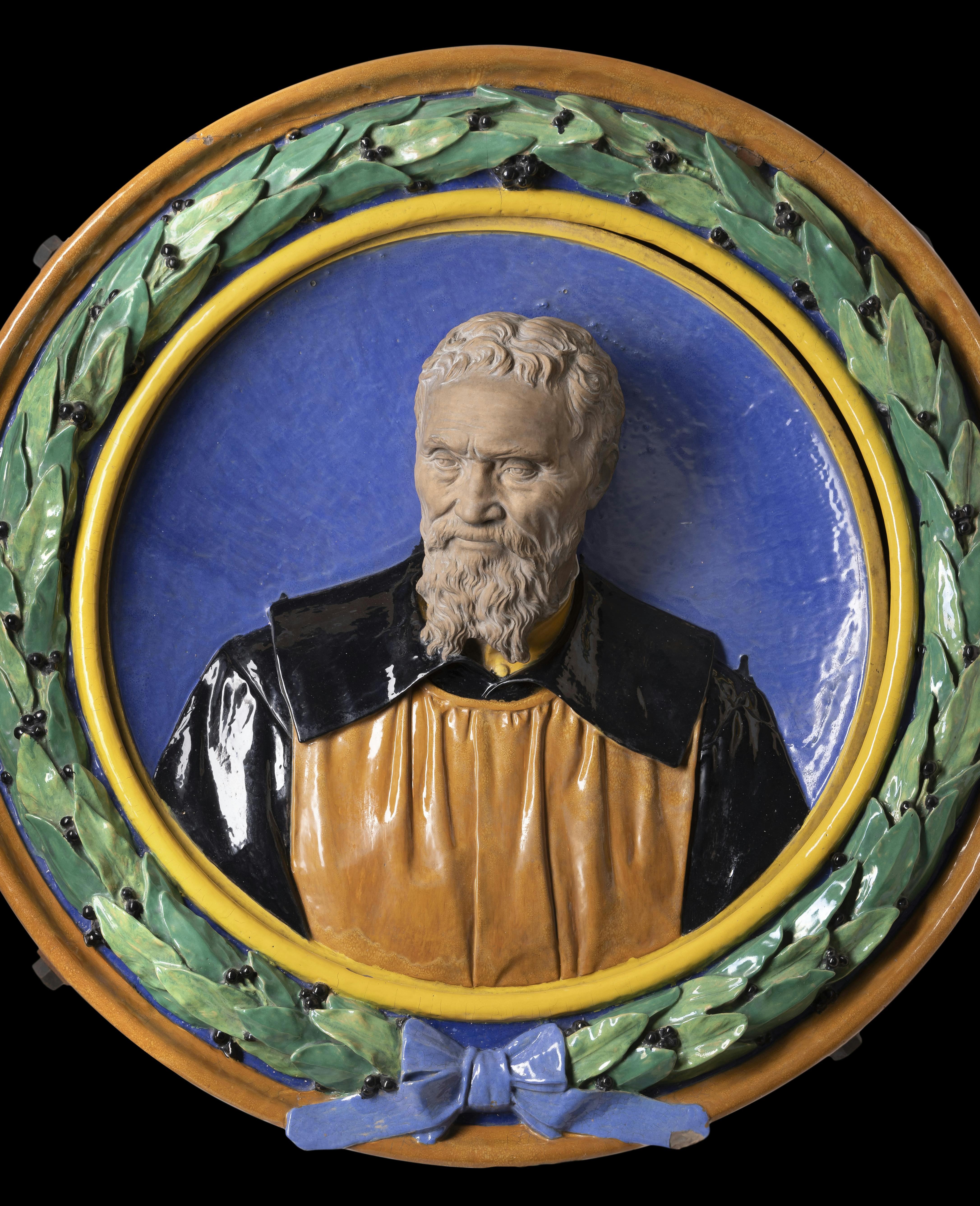
Raffaello Pagliaccetti for Manifattura Ginori, Michelangelo, terracotta and maiolica, circa 1873, Museo Ginori

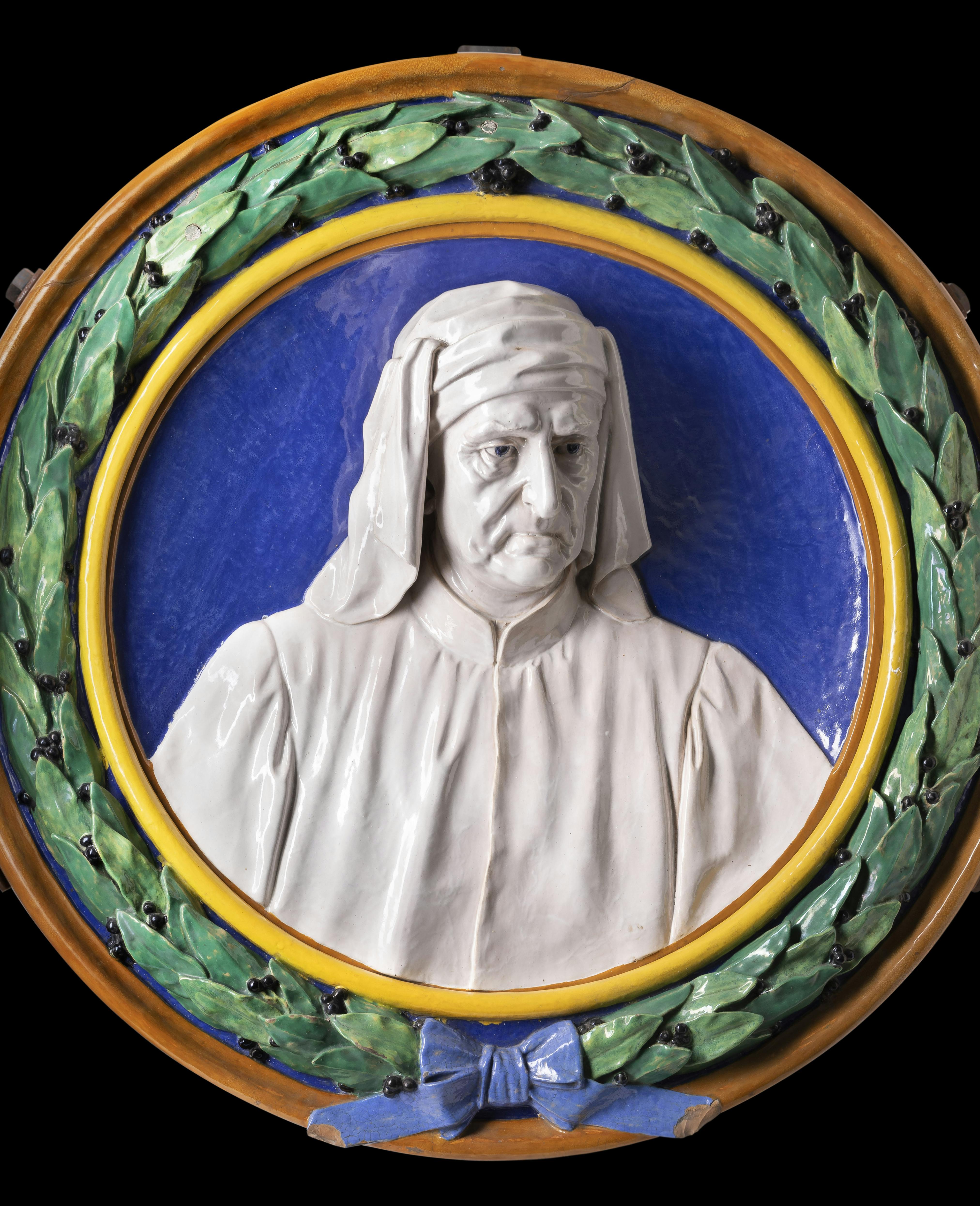
Raffaello Pagliaccetti for Manifattura Ginori, Luca Della Robbia, maiolica, circa 1873, Museo Ginori

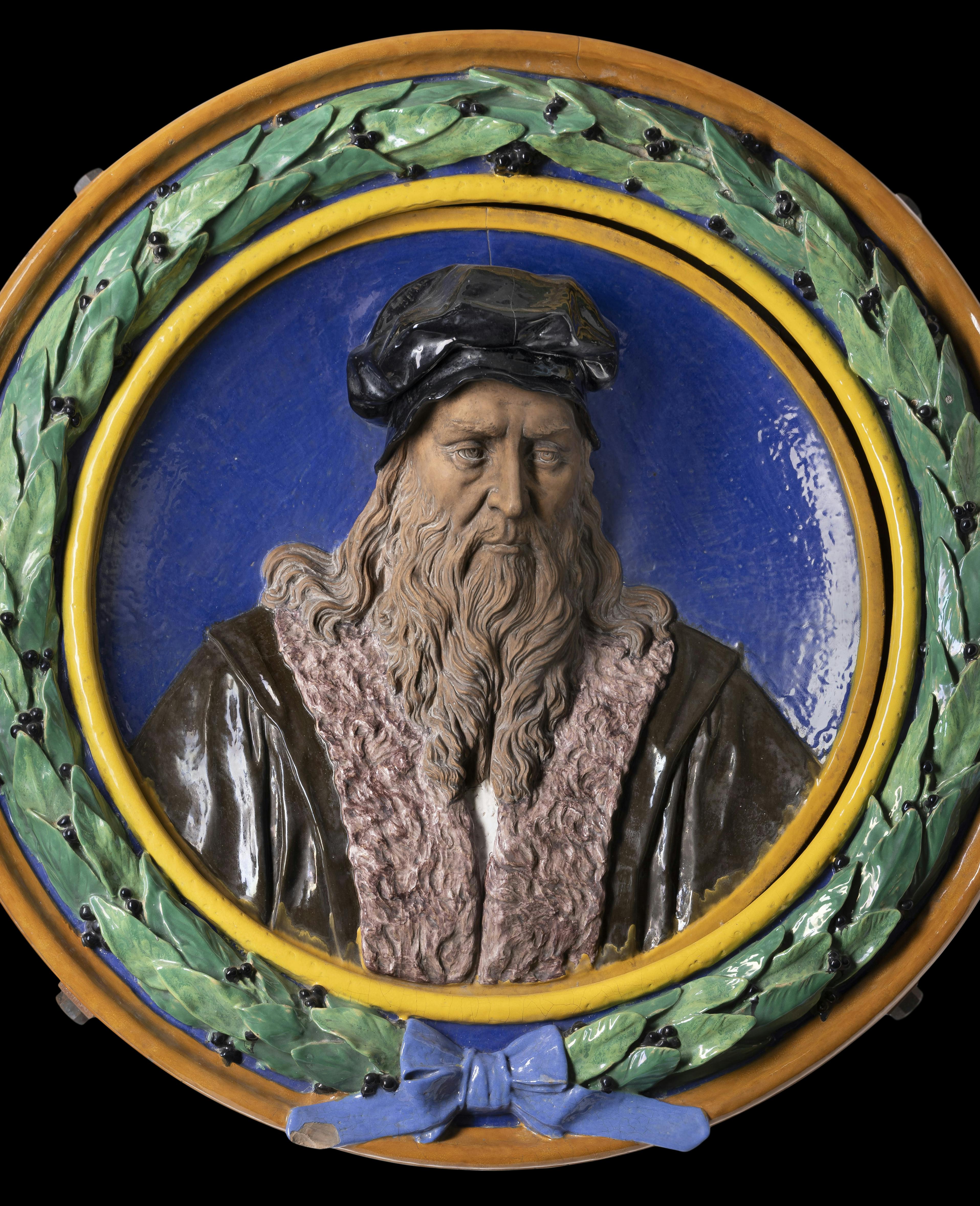
Raffaello Pagliaccetti for Manifattura Ginori, Leonardo da Vinci, terracotta and maiolica, circa 1873, Museo Ginori
Around 1883 Pagliaccetti created the commemorative monument for Marquis Lorenzo Ginori Lisci, who had managed the Manifattura di Doccia from 1847 until 1878, the year of his death. As stated on the inscription placed on the front side, the monument is positioned at the entrance of the Doccia Museum, as a tribute from the workers to the memory of the marquis.

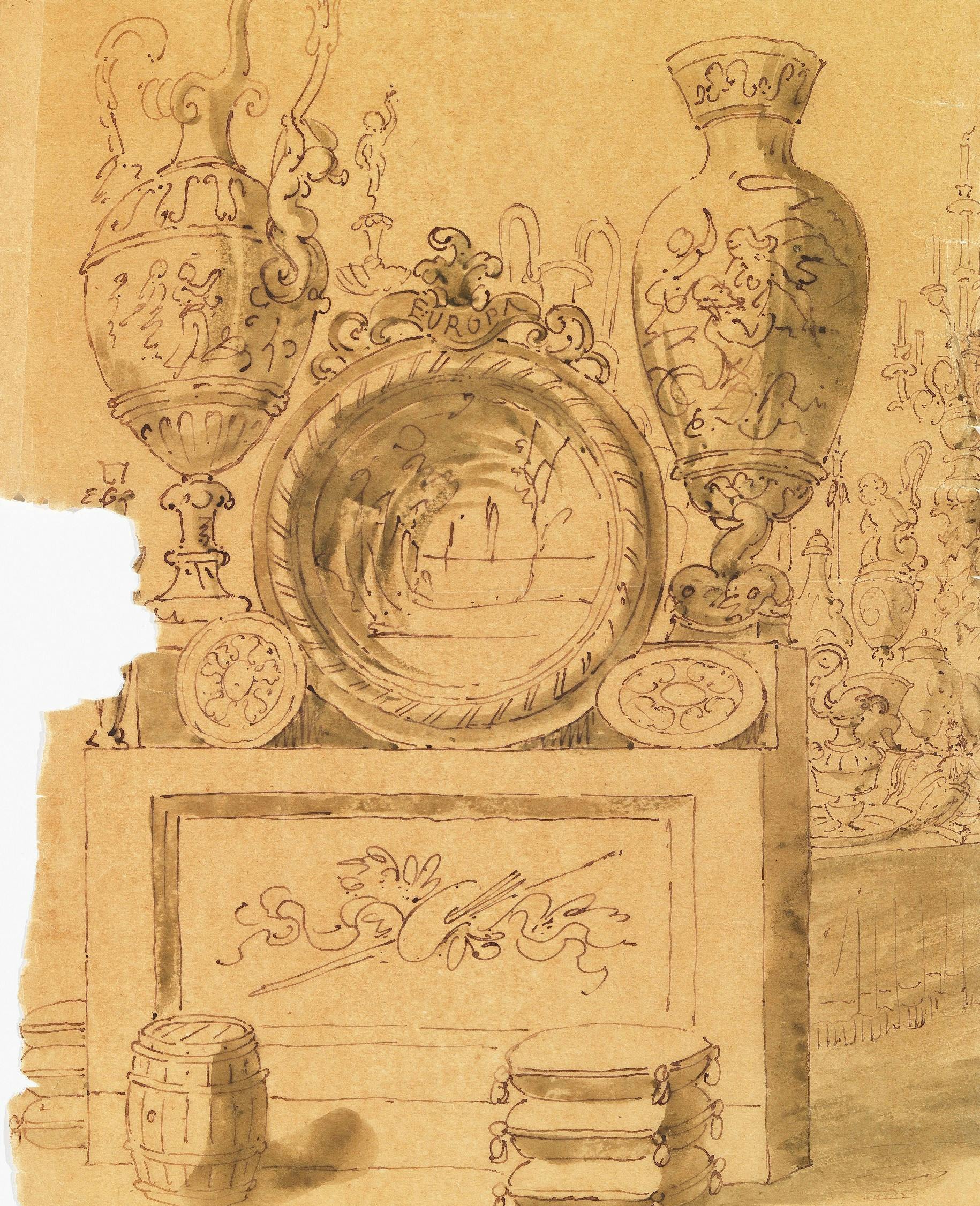
Study for the arrangement of the Ginori pavilion at the 1873 Vienna Exhibition, ink and watercolor on glossy paper, Archive of the Ginori Museum, detail

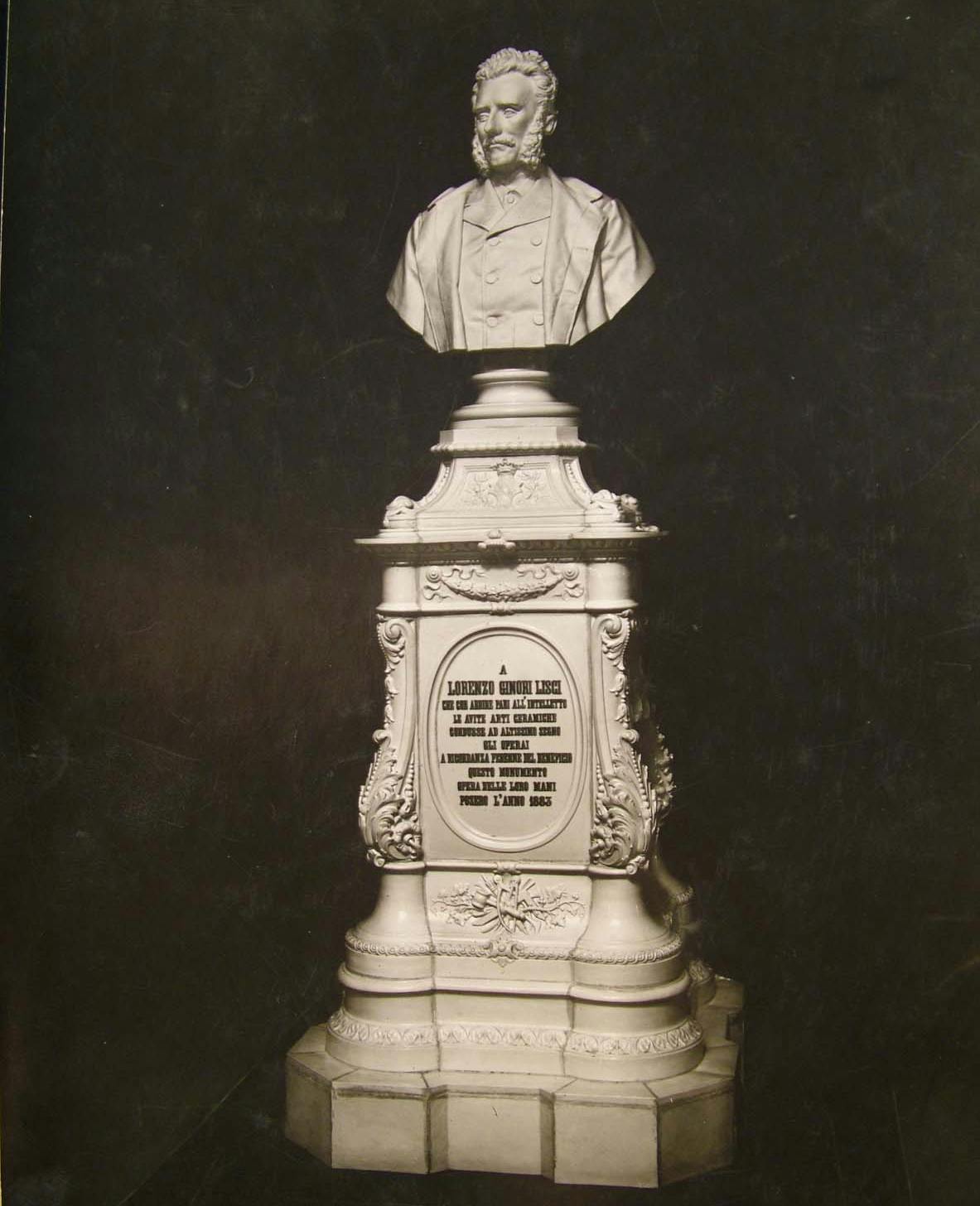
Raffaello Pagliaccetti for Manifattura Ginori, Commemorative monument to Marquis Lorenzo Ginori Lisci, porcelain, circa 1883, Archive of the Ginori Museum

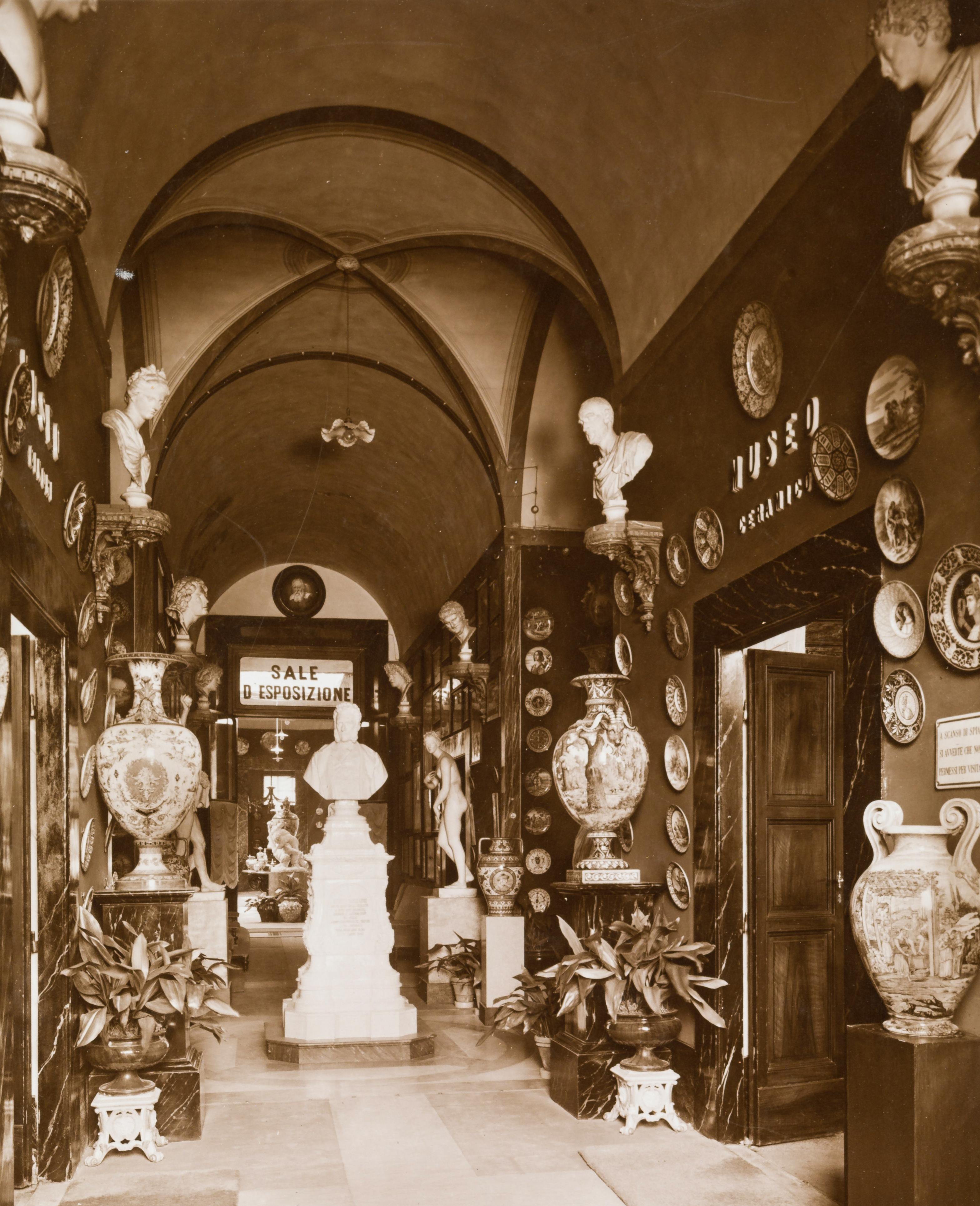
View of the entrance to the Ginori Museum in the ancient Doccia location, photograph, circa 1925-1930, Ginori Museum Archive
Recommended reading
- R. Balleri, O. Rucellai, Maioliche Ginori nella seconda metà dell'Ottocento: vicende storiche e collaborazioni artistiche, in Il Risorgimento della maiolica italiana: Ginori e Cantagalli, exhibition catalog curated by L. Frescobaldi Malenchini, O. Rucellai, Firenze 2011, pp. 77-118.
- R. Balleri, Accademici alla Manifattura di Doccia nella seconda metà dell’Ottocento: spigolature d’archivio, in «Faenza», 2, 2013, pp. 65-80.