Vase The Classical Conversation
Gio Ponti




The sumptuous decorative family conceived by Ponti in 1925, called La Conversazione classica, finds its most extensive application on this monumental six-handled maiolica jar, created for the International Exhibition of Decorative Arts in Paris and never replicated. The decoration, also presented in 1925 at the Biennale of Monza, follows a more elaborate version of the already well-established compositional scheme designed for La Passeggiata archeologica. On a background that imitates an inlaid floor featuring geometric patterns and stylized vases, twelve figures are arranged (some identifiable as the architect, the town planner, the poet, the coin expert, etc.) alternating with groups of putti, a pair of dogs, and fifteen architectural or furnishing elements. Among these we can recognize an Etruscan cista, a herm with a satyr, a headless Venus, a candelabrum, an equine protome, as well as a marble fountain presented at the second Biennale of Monza and designed by Gio Ponti himself.
The subjects are freely inspired by archaeological finds and other ancient iconographic sources, revisited in an Art Deco style. The classical antiquity is also evoked by the date in Roman numerals and by the title and signature of Gio Ponti in characters inspired by ancient lapidary script. Within the Conversazione classica series, the monochromy in ochre tones, enlivened only by the blue squares, is exclusive to this jar.
Individual figures from the same decorative family were executed in maiolica on blue, red, or brown backgrounds. In porcelain, the same decoration was instead offered with a floor-like gold background and various color combinations, or on gold agate feathered vases set on a white background.
- 01
Vase The Classical Conversation
- 02
Vase The Classical Conversation
- 03
Vase The Classical Conversation
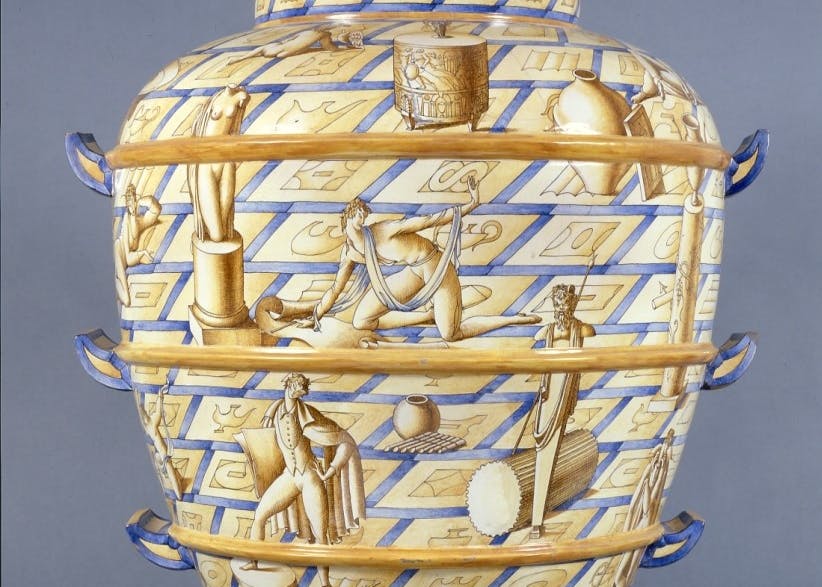
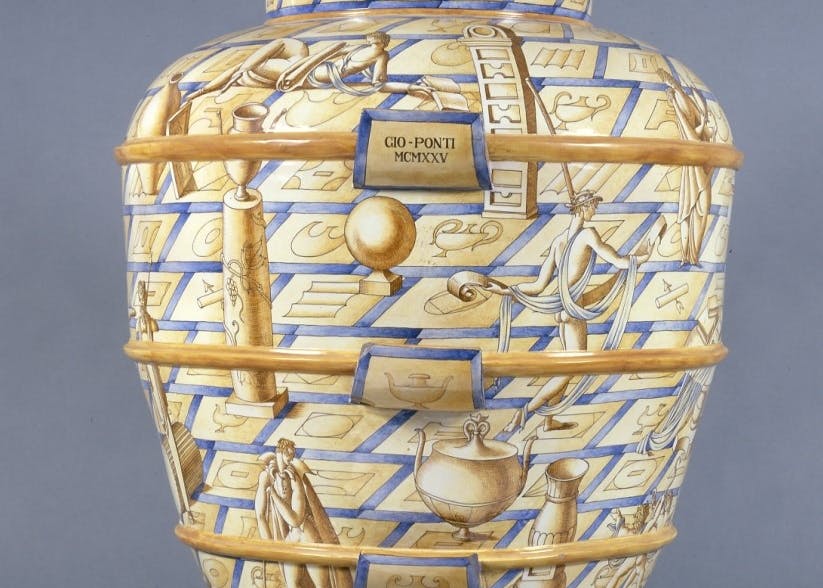
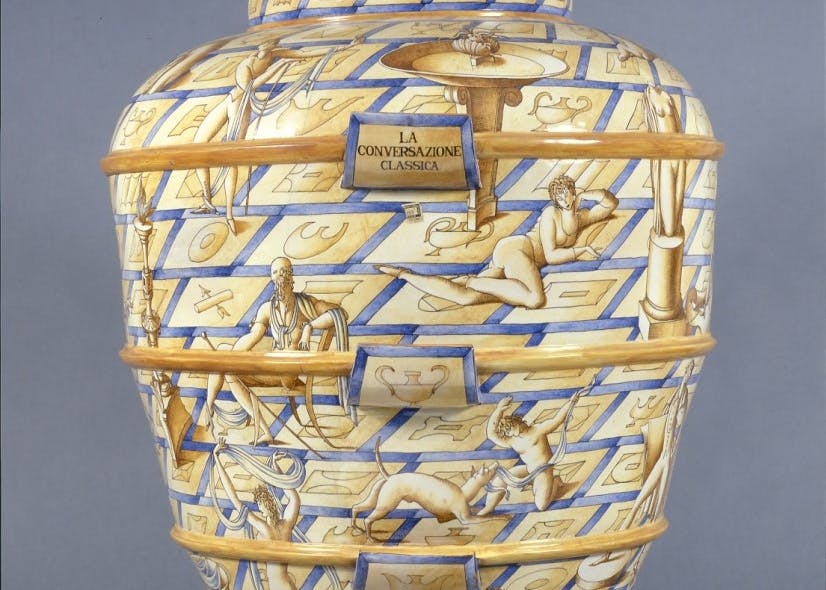
The sumptuous decorative family conceived by Ponti in 1925, called La Conversazione classica, finds its most extensive application on this monumental six-handled maiolica jar, created for the International Exhibition of Decorative Arts in Paris and never replicated. The decoration, also presented in 1925 at the Biennale of Monza, follows a more elaborate version of the already well-established compositional scheme designed for La Passeggiata archeologica. On a background that imitates an inlaid floor featuring geometric patterns and stylized vases, twelve figures are arranged (some identifiable as the architect, the town planner, the poet, the coin expert, etc.) alternating with groups of putti, a pair of dogs, and fifteen architectural or furnishing elements. Among these we can recognize an Etruscan cista, a herm with a satyr, a headless Venus, a candelabrum, an equine protome, as well as a marble fountain presented at the second Biennale of Monza and designed by Gio Ponti himself.
The subjects are freely inspired by archaeological finds and other ancient iconographic sources, revisited in an Art Deco style. The classical antiquity is also evoked by the date in Roman numerals and by the title and signature of Gio Ponti in characters inspired by ancient lapidary script. Within the Conversazione classica series, the monochromy in ochre tones, enlivened only by the blue squares, is exclusive to this jar.
Individual figures from the same decorative family were executed in maiolica on blue, red, or brown backgrounds. In porcelain, the same decoration was instead offered with a floor-like gold background and various color combinations, or on gold agate feathered vases set on a white background.