Fireplace
Eighteenth Century
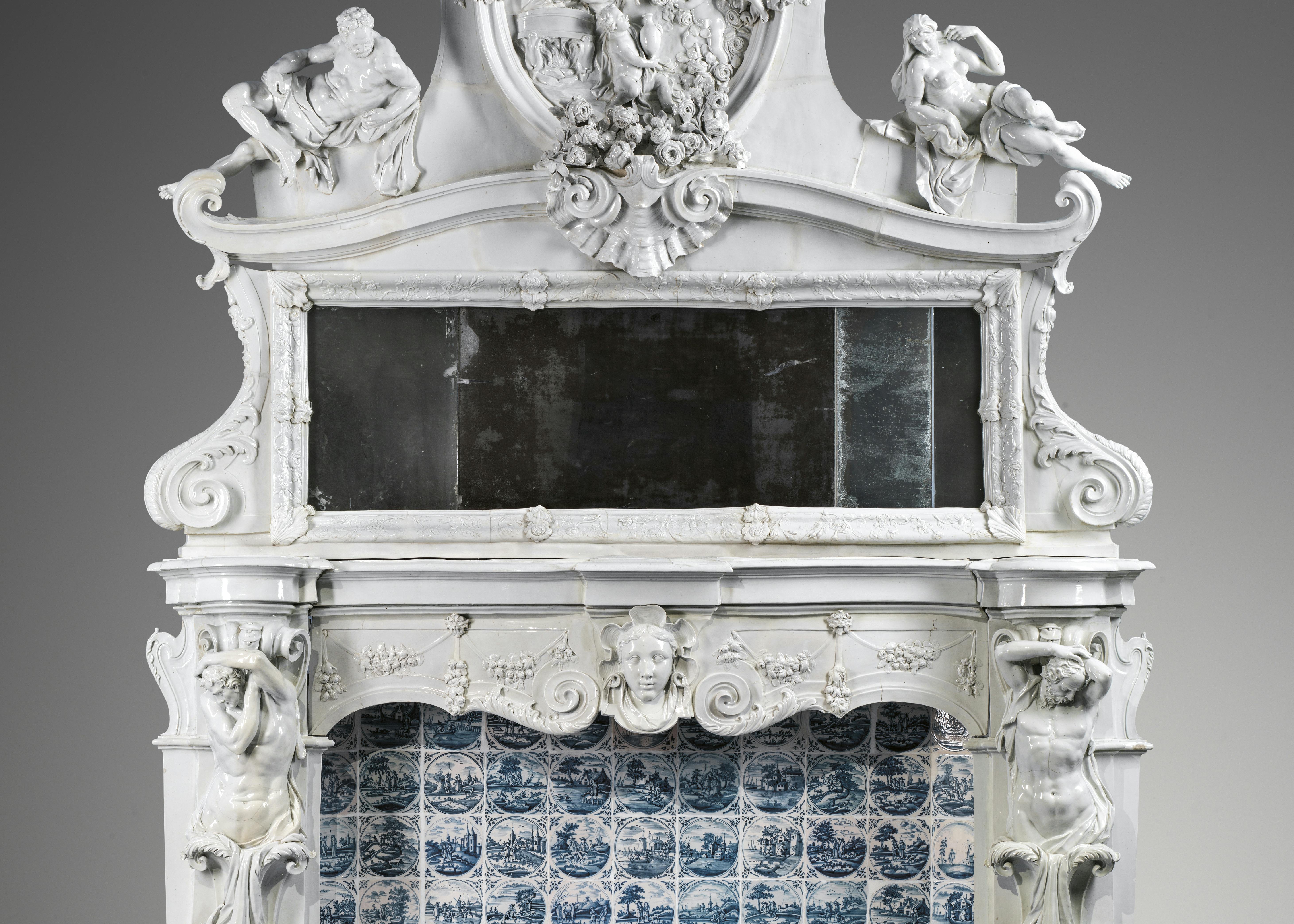
Created by the Doccia Manufactory in 1754 under the supervision of Gaspero Bruschi, the monumental porcelain fireplace was originally intended to adorn the back wall of the Gallery at Villa Le Corti, where Carlo Ginori had set up an exhibition room for the most valuable works of his production.
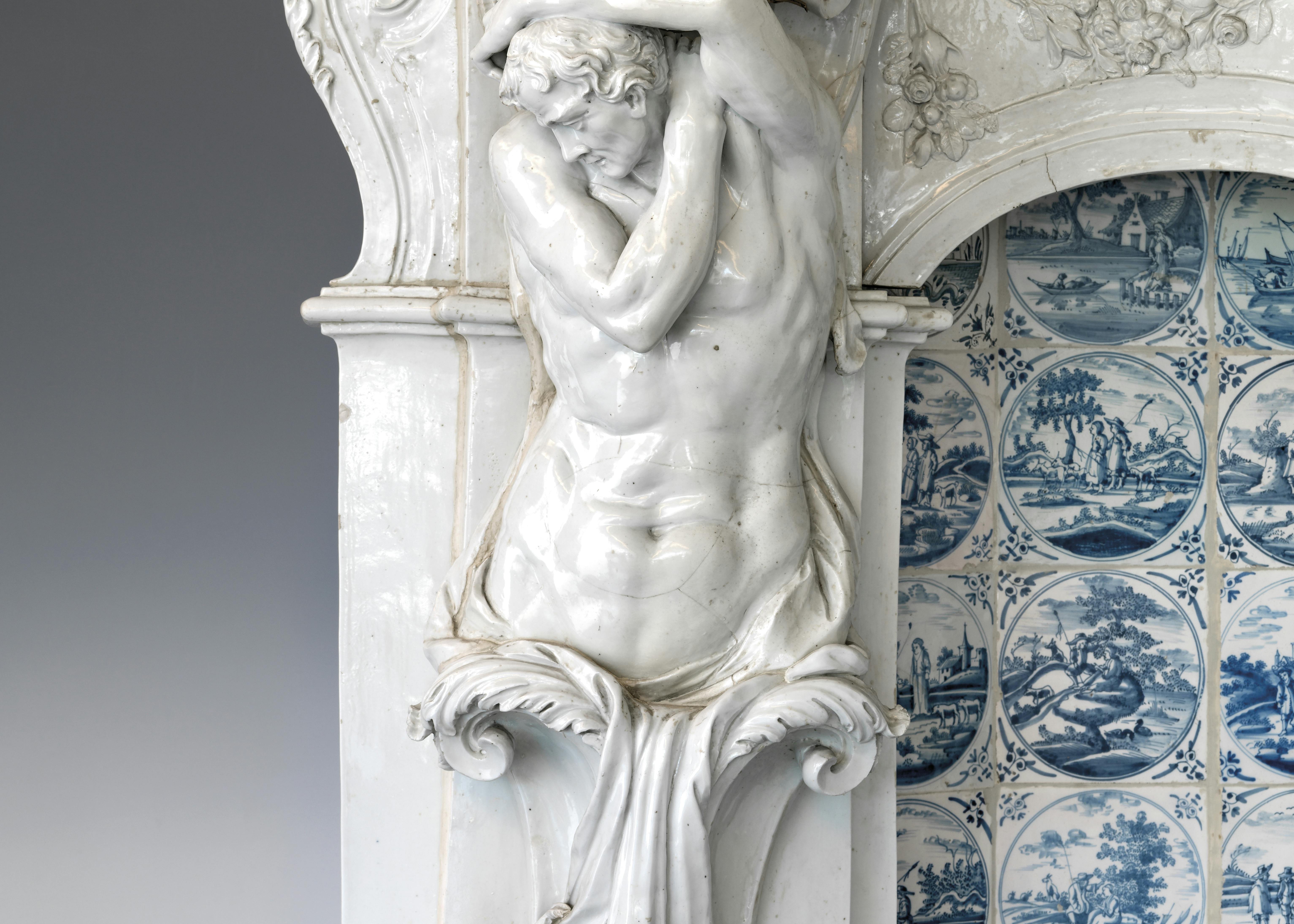

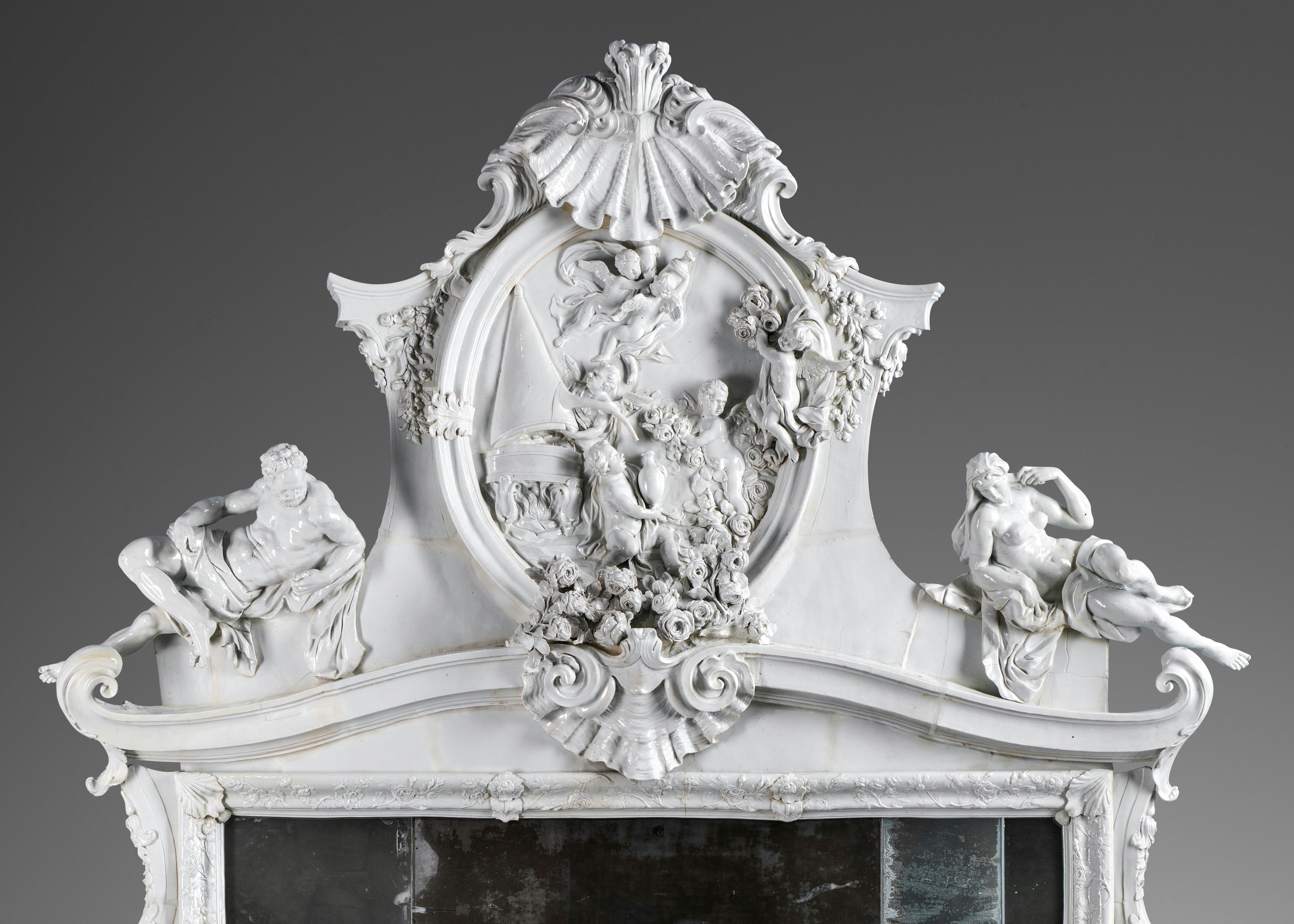
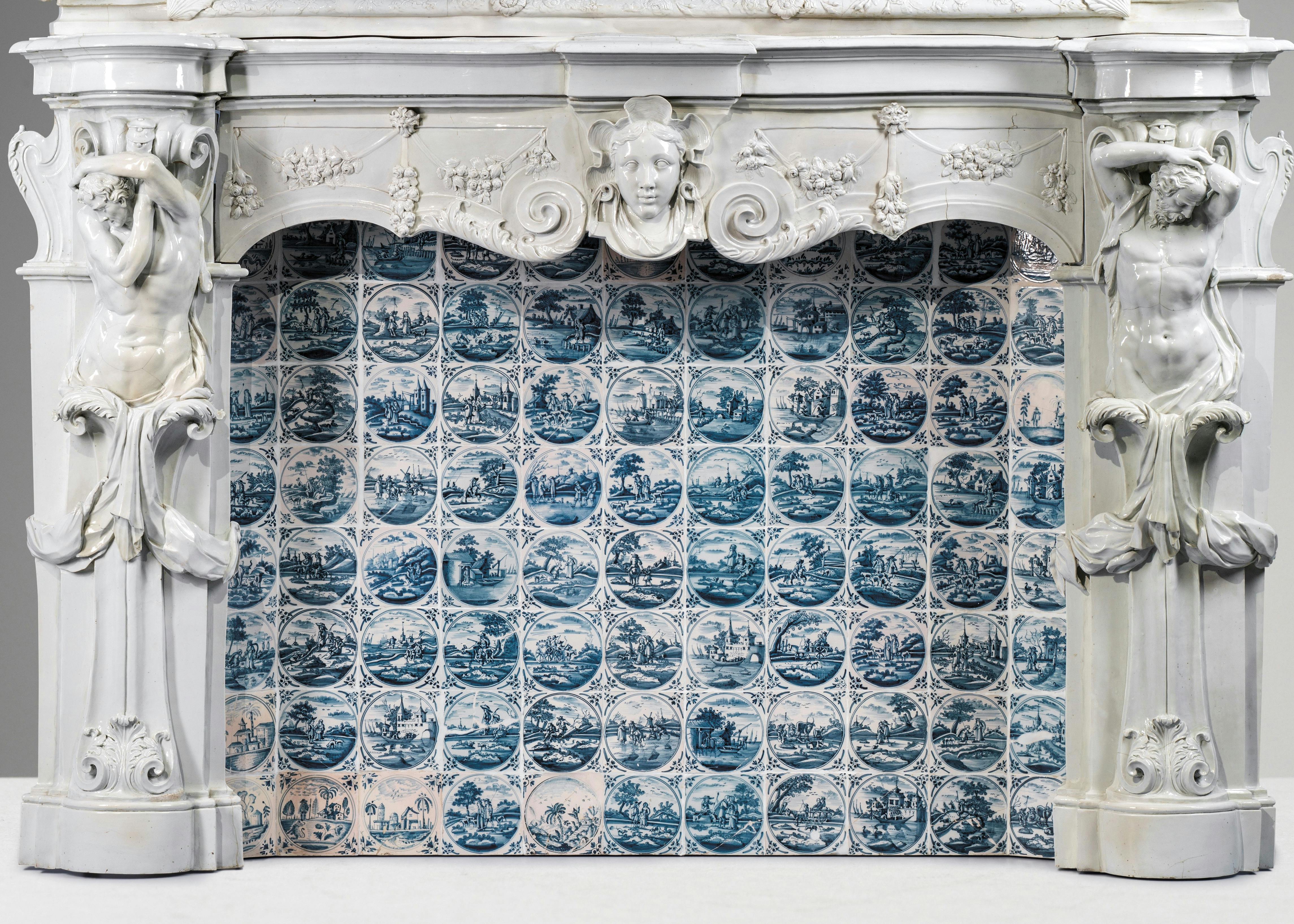
Of remarkable scenic impact, the work can be divided into three main sections: the hearth at the bottom, the mirror in the center, and the crest at the top. The first consists of an architectural structure made up of two side pilasters with telamons supporting an architrave with volutes, decorated with raised festoons, masks, and a shell valve with a female face at the center. Inside, the hearth is lined with tiles (or "ambrogette") depicting rural scenes and views painted in blue on a white background, probably of Northern European manufacture. At the center, the horizontal mirror, flanked by two connecting volutes with the dividing shelf, is enclosed within a frame decorated with floral tendrils and shells in the corners. In the upper portion, above a double curved band originating from a shell, there stand the porcelain reductions of the Michelangelesque allegories of Twilight and Dawn. The complex structure ends, at the top center, with an oval bas-relief depicting putti distilling flowers, taken from a composition by Massimiliano Soldani Benzi, capped at the top by a large shell and volutes.
A true masterpiece of the early Ginori period production, the Fireplace thus composed is a one-of-a-kind in the history of the Doccia Manufactory and attests to how the models of Florentine Renaissance and late Baroque sculpture were employed not only for the creation of small-scale sculptures but also in compositions of great scope and impressive decorative and scenic complexity.
- 01
Manifattura Ginori, Camino, porcellana, 1754, Museo Ginori
- 02
Porcelain fireplace, detail
- 03
Porcelain fireplace, detail
- 04
Porcelain fireplace, detail
- 05
Porcelain fireplace, detail
Created by the Doccia Manufactory in 1754 under the supervision of Gaspero Bruschi, the monumental porcelain fireplace was originally intended to adorn the back wall of the Gallery at Villa Le Corti, where Carlo Ginori had set up an exhibition room for the most valuable works of his production.
Of remarkable scenic impact, the work can be divided into three main sections: the hearth at the bottom, the mirror in the center, and the crest at the top. The first consists of an architectural structure made up of two side pilasters with telamons supporting an architrave with volutes, decorated with raised festoons, masks, and a shell valve with a female face at the center. Inside, the hearth is lined with tiles (or "ambrogette") depicting rural scenes and views painted in blue on a white background, probably of Northern European manufacture. At the center, the horizontal mirror, flanked by two connecting volutes with the dividing shelf, is enclosed within a frame decorated with floral tendrils and shells in the corners. In the upper portion, above a double curved band originating from a shell, there stand the porcelain reductions of the Michelangelesque allegories of Twilight and Dawn. The complex structure ends, at the top center, with an oval bas-relief depicting putti distilling flowers, taken from a composition by Massimiliano Soldani Benzi, capped at the top by a large shell and volutes.
A true masterpiece of the early Ginori period production, the Fireplace thus composed is a one-of-a-kind in the history of the Doccia Manufactory and attests to how the models of Florentine Renaissance and late Baroque sculpture were employed not only for the creation of small-scale sculptures but also in compositions of great scope and impressive decorative and scenic complexity.