Prototypes of jugs and containers with lids
Aldo Rossi
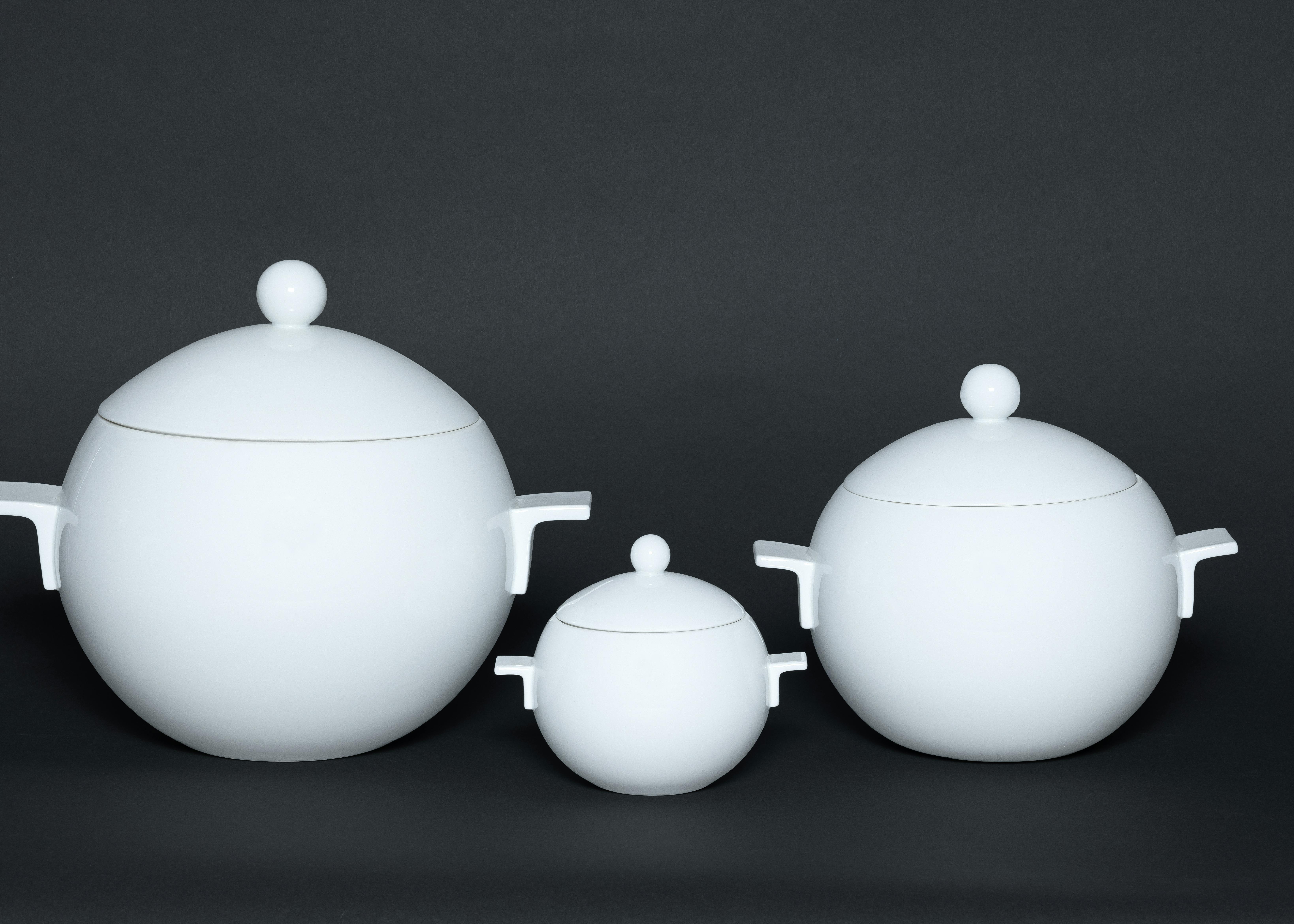
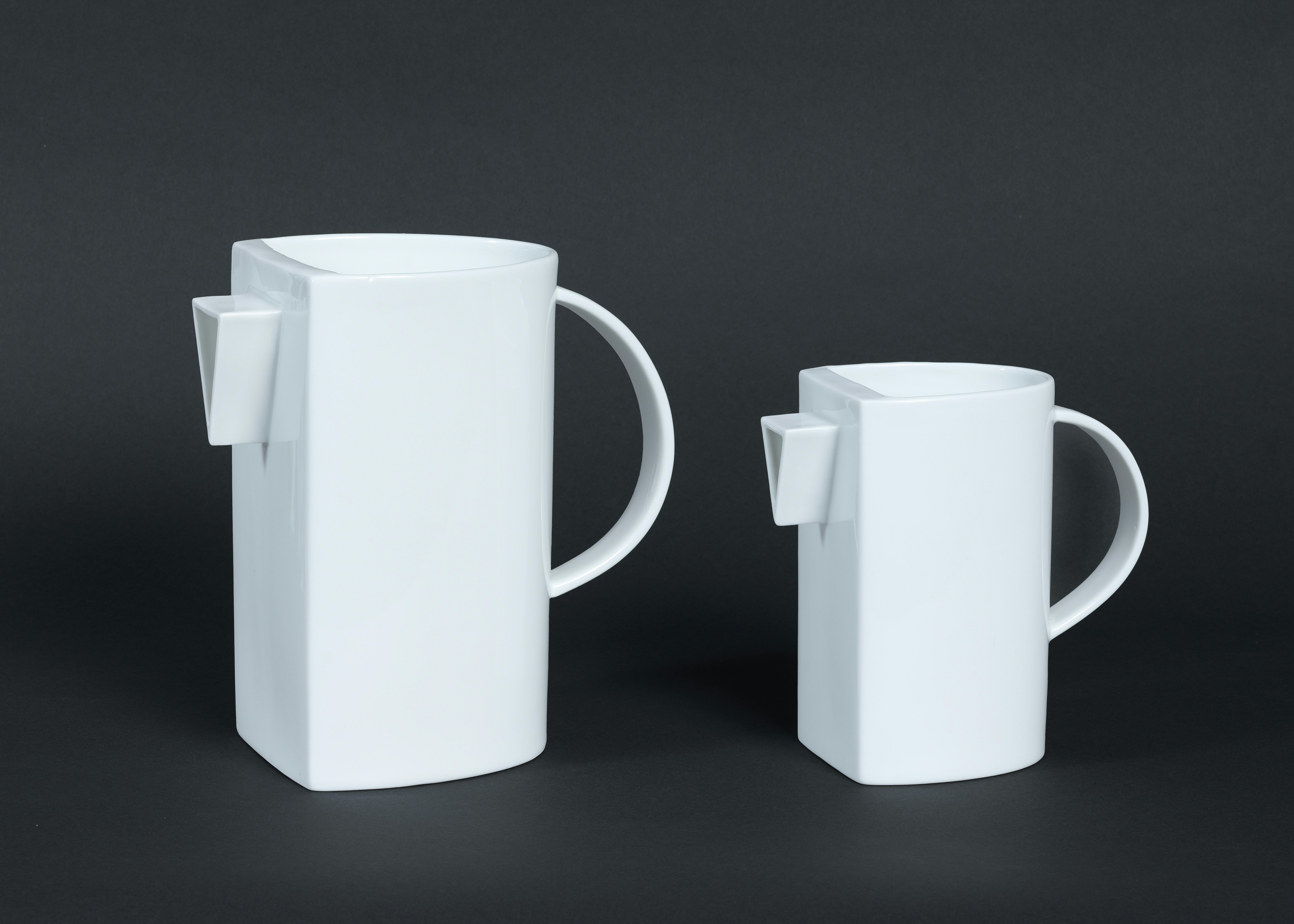
In 1985, Richard-Ginori invited nine masters of Italian design to create prototypes for the tableware of the future. Among them was the Milanese architect Aldo Rossi, who, among other things, took on the creation of a jug and three containers with lids. The prototypes conceived by Rossi on this occasion reflect some of the stylistic features of his architectural philosophy, among them the use of simple geometric shapes, such as the cube, cone, sphere, and cylinder, which were combined and varied to bring the objects to life.
The jug consists of the merging of two profiles that intersect in a directional contrast of simple lines. The vertical development of the truncated conical body is interrupted and contrasted by the spout, which fits into the initial shape and, together with the hollow silhouette of the handle, completes the fusion between the two primary triangular forms.


The containers with lids are spheres, their surfaces interrupted only by the joint line between lid and body. The knobs echo the dominant shape on a smaller scale, while the side handles are simple elements functional to practical usability.
Rossi’s creations for Richard-Ginori are part of a creative journey through industrial design that, during the same years, had led him to the design of products for the Alessi brand. Some impressions already present in the Museo Ginori’s prototypes culminated in 1994 in the design of soup tureens for Rosenthal’s line “Il Faro”.
- 01
- 02
Prototypes of a jug and a container with lid
- 03
Prototypes of a jug and a container with lid
- 04
Prototypes of a jug and a container with lid
- 05
Prototypes of a jug and a container with lid



In 1985, Richard-Ginori invited nine masters of Italian design to create prototypes for the tableware of the future. Among them was the Milanese architect Aldo Rossi, who, among other things, took on the creation of a jug and three containers with lids. The prototypes conceived by Rossi on this occasion reflect some of the stylistic features of his architectural philosophy, among them the use of simple geometric shapes, such as the cube, cone, sphere, and cylinder, which were combined and varied to bring the objects to life.
The jug consists of the merging of two profiles that intersect in a directional contrast of simple lines. The vertical development of the truncated conical body is interrupted and contrasted by the spout, which fits into the initial shape and, together with the hollow silhouette of the handle, completes the fusion between the two primary triangular forms.
The containers with lids are spheres, their surfaces interrupted only by the joint line between lid and body. The knobs echo the dominant shape on a smaller scale, while the side handles are simple elements functional to practical usability.
Rossi’s creations for Richard-Ginori are part of a creative journey through industrial design that, during the same years, had led him to the design of products for the Alessi brand. Some impressions already present in the Museo Ginori’s prototypes culminated in 1994 in the design of soup tureens for Rosenthal’s line “Il Faro”.